
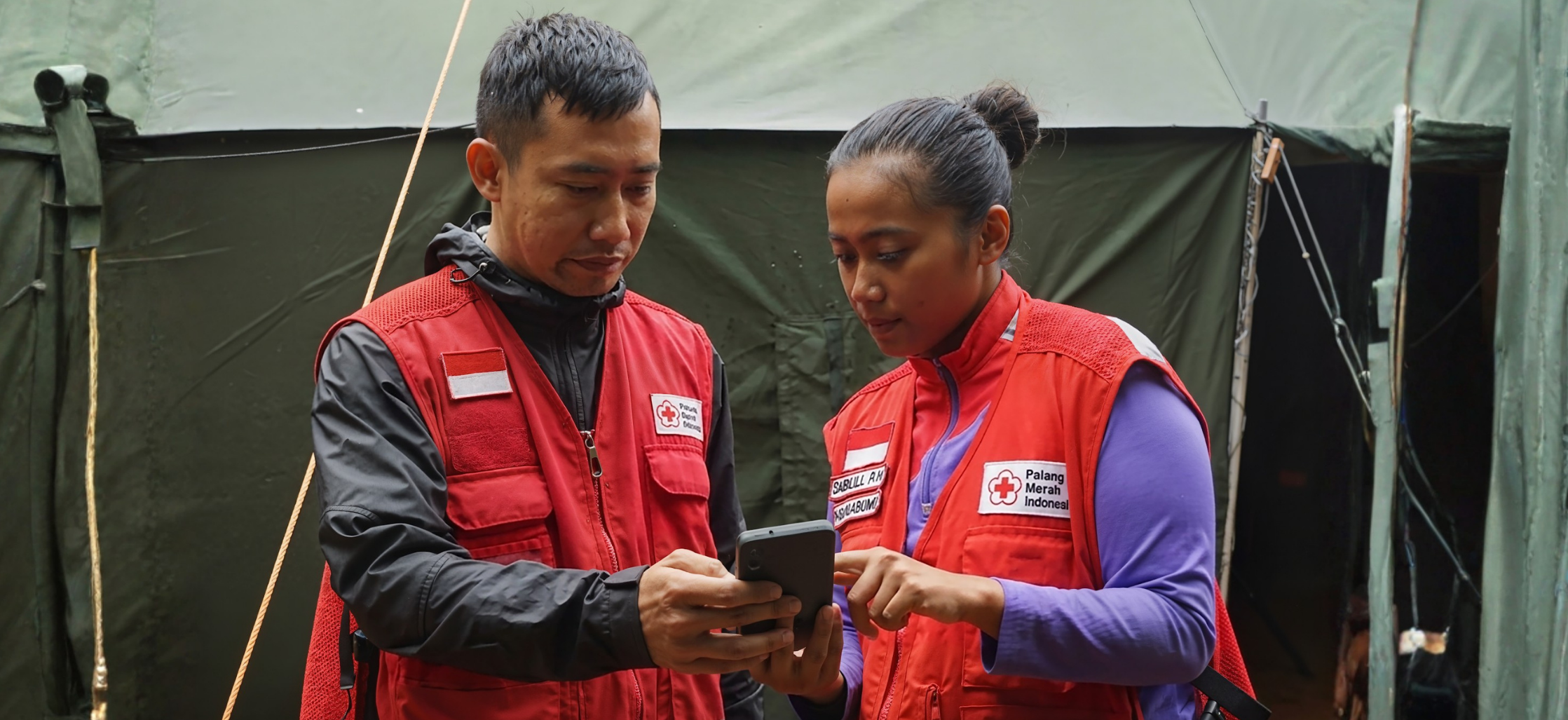
GDPC innovation funding will support an Indonesia-based Red Cross pilot of the AI-enabled Resilient Community Coach, with Leading Cities helping create a pathway to municipal adoption
WASHINGTON, D.C. and OAKLAND, Calif. — 17 August 2026 — The Global Disaster Preparedness Center (GDPC) has awarded Atma Connect innovation funding to pilot the AI-enabled Resilient Community Coach—a practical way for emergency managers to make community networks an organized part of disaster readiness. Atma Connect was selected through the 2026 QBE AcceliCITY Humanitarian Challenge, a partnership between Leading Cities, QBE, Australian Red Cross and the Global Disaster Preparedness Center. The pilot will work with Indonesian Red Cross/Palang Merah Indonesia (PMI)) and Community Based Disaster Teams in the disaster prone region of Banyuwangi in East Java, Indonesia.
Municipalities and community organizations invest in plans, warning systems, operations centers and professional response, but often lack infrastructure for activating the people already embedded in every neighborhood. In the first minutes and hours of a disaster, neighbors and local volunteers share warnings, check on vulnerable residents, support evacuations and begin lifesaving action before outside help arrives. Yet this essential capacity remains underinvested in and is rarely maintained or visible within the emergency-management system.
That need is becoming more urgent. Disasters are increasing while humanitarian funding is shrinking. Locally led preparedness is therefore not an add-on; it is essential public-safety infrastructure that can protect lives and reduce losses while making limited resources go further.
“Preparedness succeeds when communities are treated as an operational part of the disaster-management system,” said Omar Abou-Samra, Director, Global Disaster Preparedness Center. “The Resilient Community Coach has the potential to provide the continuity, coordination and visibility needed to sustain local readiness and show emergency managers where support is needed.”
“Emergency managers need more capacity, and the most scalable resilience infrastructure already exists: people who know their neighbors, understand local risks and are ready to act,” said Meena Palaniappan, founder and CEO of Atma Connect. “The AI-enabled Resilient Community Coach equips that community layer to coordinate, practice and sustain readiness—before the next emergency.”
How the AI-enabled Resilient Community Coach works
The Resilient Community Coach combines trusted protocols with local knowledge about hazards, routes, roles and vulnerable households to produce practical guidance. Community teams use the low-bandwidth tool to maintain plans, clarify responsibilities and practice scenarios. Human decisions remain central; the approach uses minimal data and emphasizes consent and community ownership.
It closes three gaps: continuity between trainings and disasters, coordination across local actors, and visibility into readiness. By tracking plan reviews, drills and recent practice, it helps emergency managers see which teams are active and where support is needed. In the United States, it could connect municipalities with Community Emergency Response Teams, VOADs, faith-based groups and trusted neighborhood networks.
From community pilot to municipal adoption
The pilot with Palang Merah Indonesia (PMI), the Indonesian Red Cross, will test the tool in a real operating environment and inform adoption in the United States and other markets. It builds on AtmaGo, which has reached more than 16 million people.
“This has been my dream since 2002: to see preparedness truly live in communities. Now, technology exists to make it possible,” said Arifin M. Hadi, Head of PMI.
Leading Cities is a key partner in the Challenge, which helps innovators navigate public systems and connects them with a network reaching more than 16,000 cities and communities. For Atma Connect, that creates a path to turn Red Cross pilot learning into public-safety infrastructure municipalities can evaluate, adopt and scale.
“Cities need practical ways to benefit from innovations like the Resilient Community Coach,” said Ava Halstead, Director of Strategic Initiatives at Leading Cities. “There’s something hopeful about watching a solution move from proving itself in one community to opening a path toward many more. Leading Cities helps build the connections and pathways that make that possible, so proof in one place can become progress in communities everywhere”
Learn more about the Resilient Community Coach:
Learn more: QBE AcceliCITY Humanitarian Challenge and Atma Connect
About Atma Connect
Atma Connect is a nonprofit social technology organization building tools and networks that help communities prepare, stay connected in crises and support one another. Its AtmaGo platform has reached more than 16 million people across the United States and Indonesia. Learn more at atmaconnect.org.
About the QBE AcceliCITY Humanitarian Challenge
The QBE AcceliCITY Humanitarian Challenge is a unique cross-sector collaboration between Australian Red Cross, QBE Foundation and Leading Cities, focused on scaling community-led solutions for climate resilience since 2024.
About the Global Disaster Preparedness Center
Hosted by the American Red Cross, the Global Disaster Preparedness Center supports innovation, learning and collaboration to strengthen disaster preparedness across the Red Cross and Red Crescent network and beyond. Learn more at preparecenter.org.
About Palang Merah Indonesia
Palang Merah Indonesia (PMI), the Indonesian Red Cross Society, mobilizes volunteers and local branches nationwide to provide disaster preparedness and response, health, blood and humanitarian services.
Media contact
Meena J. Palaniappan, Founder and CEO, Atma Connect | info@atmaconnect.org
Jessica Robbins, Senior Research Lead, Global Disaster Preparedness Center | gdpc@redcross.org